
Torque

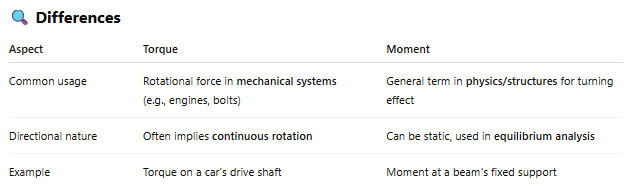
Moment and torque are very closely related — in fact, in many engineering contexts, they are used interchangeably — but there are subtle distinctions depending on usage:
✅ Similarities
Both involve a force causing rotation about a point or axis.
Both are calculated as:
Moment or Torque=Force×Distance (lever arm)\text{Moment or Torque} = \text{Force} \times \text{Distance (lever arm)}Moment or Torque=Force×Distance (lever arm)
Both have the same unit: Newton-meter (N·m) in SI units.
🛠️ Example:
Torque: A motor applying 200 N·m to turn a wheel.
Moment: A 10 N force acting 2 m from a pivot = 20 N·m moment resisting rotation.
The key reason why Electric Vehicles (EVs) can generate instant torque while Internal Combustion Engine (ICE) vehicles cannot lies in the fundamental differences in how electric motors and internal combustion engines generate power.
1. Instant Torque in Electric Motors
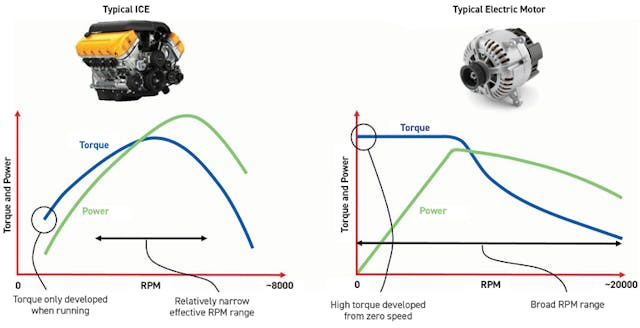
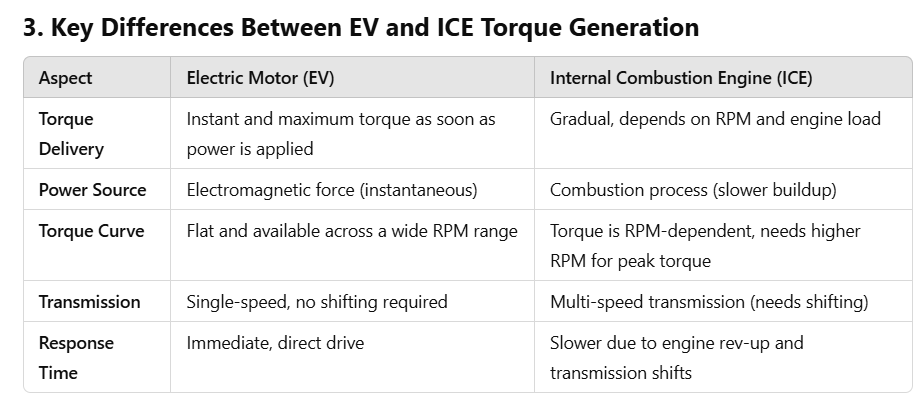
Electric motors, by their very design and operation, can generate maximum torque immediately when power is applied. This is due to several factors:
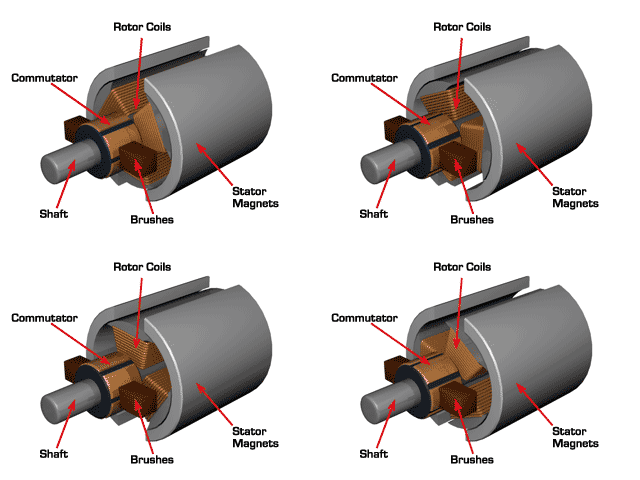
Electromagnetic Force: Electric motors operate on the principle of electromagnetic induction, where current flowing through a coil creates a magnetic field that interacts with a stationary magnet (or another coil) to create torque. When power is supplied to the motor, this interaction happens almost instantly, meaning the torque is available immediately.
No Need for RPM Build-Up: Electric motors can start turning from a standstill and immediately produce their maximum torque output. This is because the torque generated by an electric motor is proportional to the current supplied to it, and the motor can begin producing torque as soon as the current starts flowing.
Variable Speed and Torque: The torque in an electric motor is largely independent of the motor’s speed. Unlike ICE engines, which have a narrow range where they produce peak torque, electric motors can produce consistent, high torque across a broad range of speeds, including low RPM.
Direct Drive and Control: The power delivery in EVs is controlled electronically through an inverter that adjusts the amount of voltage and current sent to the motor. This gives EVs precise control over how much torque is generated and how quickly, resulting in instant response to driver input.
2. Why Internal Combustion Engines (ICE) Cannot Produce Instant Torque
Internal combustion engines, on the other hand, are fundamentally different in how they operate and generate power. Here’s why they can’t produce instant torque:
Combustion Process: ICEs rely on the combustion of fuel (gasoline, diesel, etc.) to generate power. The engine needs to go through several stages of operation to produce torque:
Air-Fuel Mixture: The engine needs to intake air and fuel, mix them, and compress the mixture in the cylinders.
Ignition: The fuel mixture is ignited by a spark, causing an explosion that forces the piston down.
Power Stroke: The piston movement turns the crankshaft, which then drives the wheels.
This process takes time to build pressure and torque. At low engine RPM, the combustion process is slower, and the engine doesn’t produce enough torque to be immediately effective.
Torque Curve and RPM Dependence: ICEs generate torque in a curve, which is RPM-dependent. At low RPM, the engine doesn't produce much torque, and it needs to accelerate through the RPM range to reach peak torque. Peak torque is typically achieved at higher RPMs, and the engine has to "rev up" to generate enough power.
This means an ICE is less responsive at lower speeds because the combustion process takes time to ramp up the torque output.
Transmission and Gear Shifting: Most ICE vehicles use gears to maintain optimal power output over a range of speeds. When an ICE vehicle starts from a standstill, the vehicle typically relies on the first gear to increase engine speed (RPM), which gradually increases the torque available. As the car accelerates, gears shift to keep the engine in its optimal RPM range. This shifting is a process that takes time, making torque delivery less immediate compared to an EV’s direct motor power.
Lag in Response: The physical mechanics of an ICE (combustion cycle, piston movement, gear shifting) contribute to a delay in the torque response. This results in a slower acceleration and less immediate response compared to an EV.
4. Why Can't ICE Vehicles Do This?
The primary limitation in ICE vehicles is the combustion process. Combustion takes time to build up pressure and create mechanical force, so the engine needs to reach a certain RPM before it can generate enough torque to move the vehicle efficiently. This delay and dependence on RPM are what prevent ICE vehicles from delivering instant torque.
In contrast, electric motors can produce torque immediately because of their simple electromagnetic design, which doesn’t rely on the build-up of combustion pressure and can provide immediate power as soon as the motor is energized.
Summary
EVs produce instant torque because electric motors generate torque instantly as a result of the flow of electricity through the motor, without any need for RPM buildup.
ICE vehicles cannot produce instant torque due to the time required for combustion, and the engine’s torque depends on its RPM. As a result, ICE vehicles need to accelerate and reach higher RPMs before they can produce enough torque, which is a slower process compared to EVs.